

Inner Peace
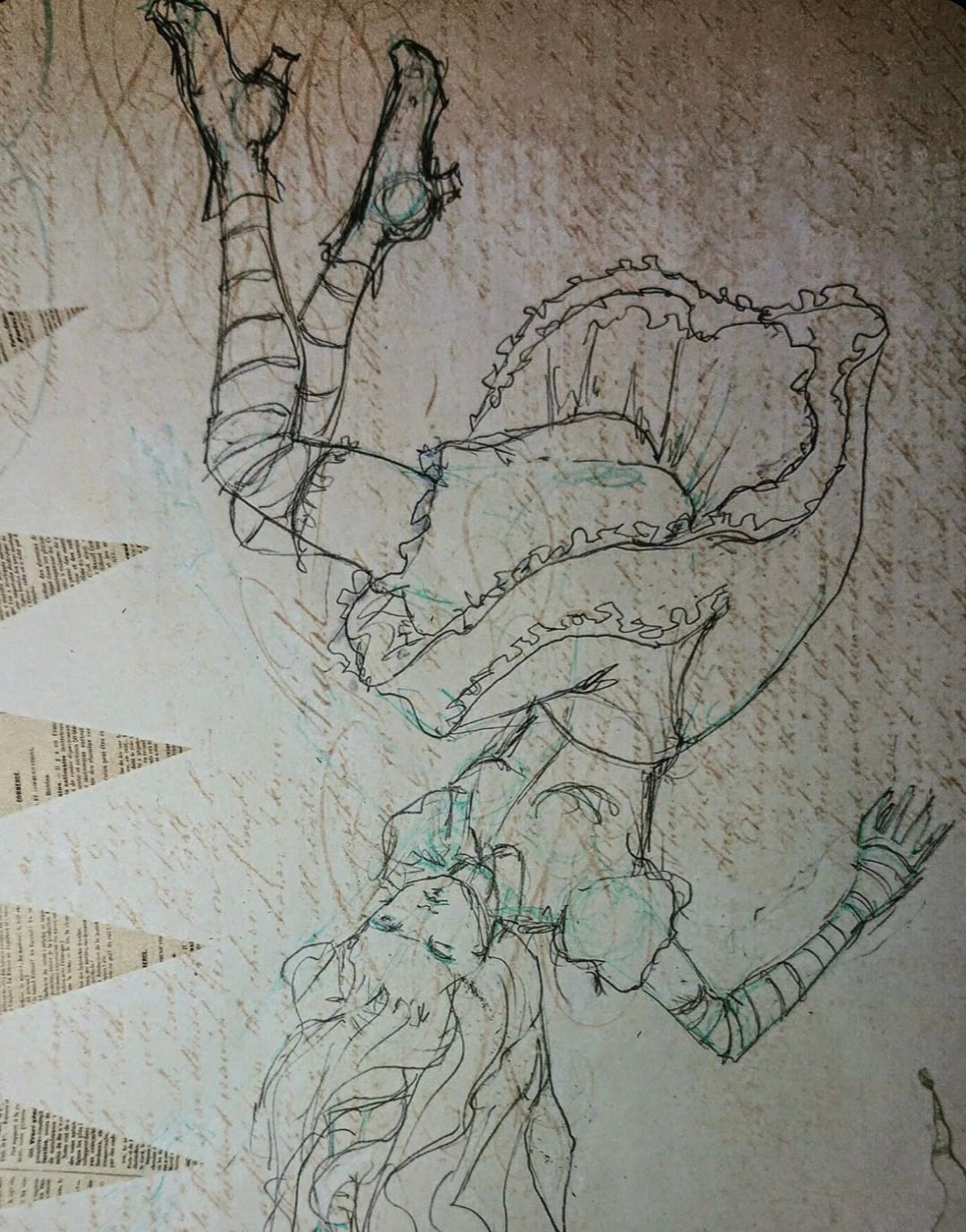
Falling Down the Rabbit Hole and Finding a Quiet Place to Land

They say silence is golden. For women, it’s often misread as grace.
I went to an all-girls middle and high school where we were taught to speak up. Use your voice. Claim your space. Raise your hand higher. Louder. Stronger. Smarter. Don’t shrink.
We were told our silence had been historically enforced. Our stories erased. Our opinions dismissed. Our "nos" ignored. And so the antidote was volume. Urgency. Presence. We were taught to fill the air with our ambition, with questions, with fire. To speak not only for ourselves but for the women who hadn’t been allowed to.
I believed in that doctrine. I still do. It gave me power. Language. Sisterhood. A sense of place in a world not built for us.
I became very good at filling the air. But I think the pendulum may have swung too far, and that’s when I started falling. I was taught to speak, so I did. A lot. The line between expression and empowerment blurred, and I talked right over it.
I’ve always had a lot to say. I can talk to a wall. I’ve argued points I don’t even believe in just to see where the conversation might go. I like language. I like sharpening ideas until they gleam.
I’m not just afraid of being misunderstood. I’m actually interested in it. I want to untangle the knots. I want to be heard exactly right.
But lately, I’ve started to wonder if all that talking is also a kind of defense. Maybe I’m bracing for rejection by over-delivering clarity. Maybe I’m explaining myself out of fear, just more elegantly.
I’m still learning the difference between expression and performance. Still learning that over-explaining isn’t always power. Sometimes, it’s fear in good shoes. And sometimes, it isn’t even explaining. Sometimes, it’s just talking.
Talking to fill the space. Talking because silence feels like failure. Talking because if I can keep the room alive, maybe I’ll stay welcome inside it.
I catch myself doing it all the time: Padding a sentence with softeners. Saying "just to clarify" when there’s nothing unclear. Offering caveats to people who haven’t asked for any. Telling stories with too many details, doubling back to make them more palatable.
I hear myself doing it, and sometimes, I can’t stop. My voice gets faster. My breath gets shallower. I feel my hands moving more than they need to. I’m suddenly too aware of the shape my mouth is making.
And afterward, I walk away buzzing. Raw. Overexposed. Like I left too much of myself on the table.
I replay what I said and I wonder how it landed. I feel weird. A little off. Like I shared something sacred and then immediately regretted giving it away.
Because I want to be liked. To be seen as warm. Smart. Good. The kind of woman who shares her feelings and then cleans up after them. Who apologizes for crying after opening up, who makes sure her vulnerability didn’t make anyone else uncomfortable. The kind who keeps the conversation going, no matter how tired she is.
But peace, I’m learning, doesn’t bloom from being understood or being heard all the time. I think it takes root in the quiet after you stop trying.
So now, I’m trying to learn to crave the quiet. Not the silence of being shut down. The silence of shutting up on purpose.
I’m starting to think of silence as an altar. Not empty, sacred. Not withholding, just whole.
It’s where I go to remind myself that I don’t owe anyone a TED Talk every time I open my mouth. It’s the breath I take before I say something, and then decide not to. It’s me, drinking my tea and keeping my brilliant opinions to myself for once.
The first time I said no without a trailing explanation, my heart thudded like I’d committed a crime. My college roommate wanted me to go out with her to some party at some fraternity I don’t even remember the name of now.
I wanted to stay in. I wanted a night to be still, to breathe, to not have to shout over music or pretend I was in the mood for a tequila shot.
But saying no felt loaded. Like I was rejecting her, or being lame, or letting someone down.
I said no. Then I braced for lightning. But it didn’t come. Just silence. She understood, smiled, and skipped out the door.
I had simply chosen myself.
Which, for a woman raised to soothe, to show up, to keep people company, can feel like a sin.
But here’s the truth: Sometimes the most loving sound you can offer — to others, to yourself — is none at all.
Cornelia Connelly was the founder of the all-girls school I attended. Her name was spoken in assemblies like scripture. We were told she was a woman of faith, vision, and radiant self-sacrifice. That she left her marriage to follow God’s call. That she gave up everything, even her children, to found schools for girls like us.
They told us she chose it freely. That she found peace in her calling. But even as a teenager, I had questions.
Did she ever want to scream? Was her silence sacred, or was it survival? Was inner peace something she found, or something she performed because the alternative wasn’t allowed?
Because here’s what they didn’t always tell us: Her husband decided to become a Catholic priest, and the Church, the very institution she gave her life to, sided with him. He took their children from her. Legally. Permanently.
She was forced to fight for her own motherhood. And lost.
They didn’t tell us that she tried to resist institutional control and was silenced. That her letters, her grief, her rage — all of it was flattened into a holy narrative about cheerful submission.
They canonized her dignity but edited out her devastation.
The same Church that praised her obedience helped erase the parts of her that were unruly, inconvenient, or too alive.
Maybe Cornelia didn’t scream, not because she didn’t want to, but because she knew no one would listen. Maybe the altar of silence isn’t always lit by choice. Maybe I come to it now not to surrender, but to remember I have a choice she didn’t.
And maybe my seeking — the part of me that spirals down rabbit holes, that bristles at half-truths, that needs to know — is partly because I was raised in a place that taught us to be curious...but only within certain boundaries.
We were told to speak up. But the woman who built our institution was silenced. We were told to claim our stories. But hers had been redacted.
Maybe that’s why peace has felt like rebellion. Why rest feels dangerous. Why silence has taken me so long to trust.
I think my urge to explain everything is connected to my urge to understand everything. To crack the code. To get ahead of pain.
My numerology is 7: the seeker, the mystic, the analyst, the one who digs beneath surfaces. I’m also a Libra sun, which means I crave harmony, fairness, truth, but I also tend to lose my footing when too many conflicting truths are flying at once.
It tracks. I love a good mystery. I can spiral down a conspiracy theory for hours. Not out of paranoia, but because I want to understand the machinery behind belief. I want to know why people cling to certain narratives. I want to see how a truth fractures. I want to find the pattern inside the chaos.
And yes, sometimes it is about politics and media. It’s about the feeling that I’m not being told the whole story. That something is being hidden, withheld, manipulated.
But it’s also about people. And it’s about me.
I want to be safe. I want to be right. I want to protect myself from disappointment or betrayal by predicting it before it comes.
So I dig. And I talk. And I try to explain it all, to myself, to others as if clarity alone could ward off pain.
But I’m learning that there’s a threshold. Even truth-seekers have to rest. That past a certain point, it stops being wisdom and starts becoming obsession.
There have been nights I’ve gone too far down the rabbit hole. Clicking through theories, timelines, TikToks, forums. At first, it feels like illumination. Like I’m catching up to something the world doesn’t want me to see.
But after a while, the air gets thin. My chest tightens. I start looking over my shoulder. I lose track of what I was even looking for.
It stops being about enlightenment, or peace, or truth. It becomes dark.
I become dark. Not wiser — just wired. Not empowered — just overwhelmed. Not grounded — just spiraling, blurry at the edges.
And that’s when I know I’ve gone too far. That I’ve mistaken seeking for safety.
So I close the tabs. I walk outside. I touch something real.
Because the truth, the one that doesn’t fracture, is this: Not everything needs to be known. Not everything needs to be said. Not everything deserves my nervous system.
When I go down the rabbit hole, it starts to feel like The Matrix. Do I want the red pill or the blue pill?
Sometimes I think red. Because I want the truth, no matter how painful. I want to see, no matter how brutal the reality is. There’s a kind of nobility in that. The dignity of knowing, even when it hurts.
But no one talks about what happens after the pill. No one warns you how cold it gets once the illusion is gone. How lonely it feels to carry what others aren’t ready to see. How you can become addicted to the burn. Chasing it. Calling it clarity.
We glamorize the moment of awakening. We glorify the awakened. But we rarely speak of the aftermath.
What if peace isn’t found in the unveiling? What if peace is found in knowing when to stop looking?
Sometimes, peace is not waking up to more. It’s lying back down in your own body. Staying with what’s real, not what’s revealed.
Sometimes, peace is saying no to yourself. Refusing to know more. Refusing to go deeper just because you can. Refusing to trade your stillness for a sliver of false control.
Sometimes, peace is stepping back from the fire you lit. Letting the questions burn without throwing yourself in.
Sometimes I think I’ll choose the blue pill. Because I want the dream, the sweetness of not knowing. I want to scroll past the chaos and just let the world be what it says it is. To believe the version of things that’s easier to hold.
I mean, Gatsby did it. He stared at that green light like it was a prophecy, not a porch lamp.
And honestly? Same. There are days where I, too, want to romanticize a dream until it glows. To pretend the illusion is noble. That longing is glamorous. That ignorance is in fact bliss.
Sometimes I think I’d rather not see it all. I’d rather have one true friend and a warm drink. Rather water my plants and not worry about what’s unraveling across the ocean. Rather write a paragraph that means something than read a thread that fractures everything.
There’s peace in not knowing. There’s also guilt. Because isn’t ignorance just another kind of privilege? Isn’t tuning out just a different way of opting in — to safety, to silence, to the lie?
I don’t know. I don’t always want the truth. And I don’t always want the illusion.
Mostly, I want to live in a world where I can choose when to look and when to rest. Where I don’t have to swallow either pill. Where I can sip something slower. Where I can return to myself before returning to the feed.
I don’t know what I’ll choose tomorrow — the red pill or the blue.
But tonight, I choose quiet. I choose not-knowing. I choose inner peace. And I return to the altar of silence.
Inner Peace Affirmation: In times of stress of conflict, I focus on creating a space of calm and balance within. My inner world creates my reality. I ask the Universe for help to guide me and enlighten me so that I may master my thoughts and emotions. I am peaceful.
Mystic Memoirs is an essay experiment inspired by my oracle deck.
I pull the cards not to predict what’s coming, but to anchor myself in what’s already here. Each card offers an idea or theme, and I pay attention to how that idea moves through my life.
The process is simple: draw a card, sit with its message, and let life take its course. I notice what memories surface, what patterns repeat, and what experiences begin to feel charged with meaning. From there, I write. Eventually, an essay-ish thing forms, a small truth. When it’s finished, I publish and pull again.
This is card #3.